
Our Story
Abu Simbel Travel Guide
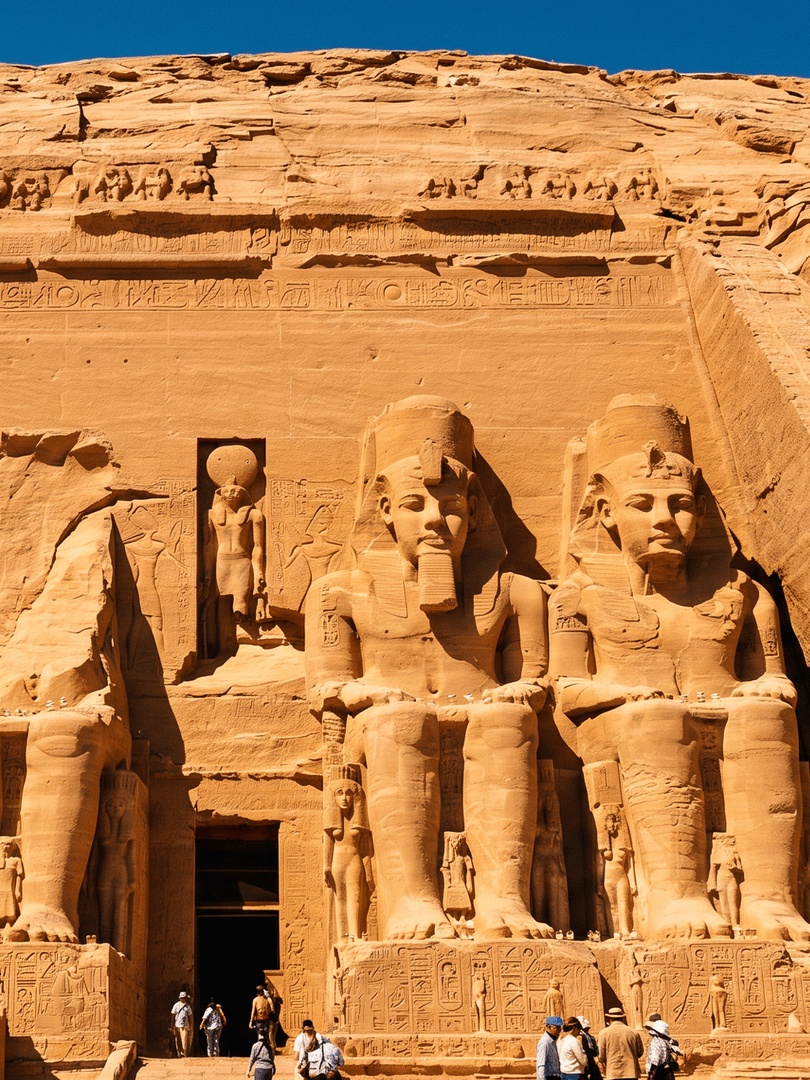
Discover Abu Simbel, one of Egypt’s most breathtaking archaeological treasures. Carved into the cliffs beside Lake Nasser and guarded by colossal statues of Ramses II, the temples of Abu Simbel represent one of the greatest achievements of ancient Egypt and one of the world’s most remarkable UNESCO World Heritage Sites.
overview
Few places in Egypt leave visitors speechless.
Abu Simbel is one of them.
Located in southern Egypt near the Sudanese border, Abu Simbel is home to two monumental temples commissioned by Pharaoh Ramses II over 3,200 years ago.
Built to celebrate royal power, military victories, and divine authority, the temples remain among the most impressive monuments of the ancient world.
Yet Abu Simbel’s story extends far beyond the pharaoh who built it.
In the 1960s, the entire temple complex faced destruction due to the construction of the Aswan High Dam. In one of the greatest archaeological rescue projects ever attempted, the temples were carefully dismantled and relocated to higher ground.
Today, Abu Simbel stands not only as a masterpiece of ancient Egyptian architecture but also as a symbol of international cooperation and heritage preservation.
For many travelers, visiting Abu Simbel becomes the highlight of their entire journey through Egypt.
WHY VISIT ABU SIMBEL?
Abu Simbel offers one of the most unforgettable experiences in Egypt.
Highlights include:
✔ Colossal statues of Ramses II
✔ UNESCO World Heritage Site
✔ The Temple of Queen Nefertari
✔ Extraordinary ancient engineering
✔ Lake Nasser scenery
✔ The famous Sun Festival
✔ One of Egypt’s most photogenic sites
✔ A remarkable relocation story
✔ Exceptional historical significance
✔ Easy access from Aswan
WHERE IS ABU SIMBEL?
Abu Simbel is located approximately:
280 km south of Aswan
Near the shores of Lake Nasser.
Travel options include:
Private Vehicle from Aswan
Most popular option.
Travel time:
Approximately 3–4 hours each way.
THE HISTORY OF ABU SIMBEL
The temples were commissioned by Pharaoh Ramses II during the 13th century BC.
Their purpose was both religious and political.
The site served to:
- Demonstrate Egyptian power
- Honor the gods
- Impress neighboring Nubian populations
- Celebrate Ramses II’s reign
The Great Temple was dedicated to:
- Amun-Ra
- Ra-Horakhty
- Ptah
- Ramses II himself
The smaller temple was dedicated to:
- Queen Nefertari
- The goddess Hathor
Together they form one of the most ambitious architectural projects of ancient Egypt.
THE GREAT TEMPLE OF RAMSES II
The Great Temple is the centerpiece of Abu Simbel.
Its façade features:
Four colossal statues of Ramses II
Each standing approximately:
20 meters high
Visitors immediately understand why Abu Simbel is considered one of Egypt’s most awe-inspiring sites.
Inside, visitors discover:
- Massive halls
- Colossal pillars
- Detailed reliefs
- Battle scenes
- Religious ceremonies
Among the most famous carvings are depictions of the Battle of Kadesh, one of the best-known military campaigns of the ancient world.
THE TEMPLE OF QUEEN NEFERTARI
Often overshadowed by the Great Temple, this smaller temple is one of Egypt’s most beautiful monuments.
Its significance cannot be overstated.
Very few queens in ancient Egypt were honored with a temple of such scale.
The façade features statues of:
- Ramses II
- Queen Nefertari
displayed at nearly equal height, a rare honor in ancient Egyptian art.
Inside, visitors encounter elegant reliefs dedicated to Hathor and Nefertari
THE ABU SIMBEL RELOCATION PROJECT
One of the most extraordinary aspects of Abu Simbel is not ancient—it is modern.
During construction of the Aswan High Dam, rising waters threatened to submerge the temples permanently.
An international rescue campaign led by UNESCO was launched.
Between 1964 and 1968:
- The temples were cut into large blocks
- Carefully documented
- Moved piece by piece
- Reassembled 65 meters higher and 200 meters inland
The operation remains one of the greatest archaeological preservation projects in history
THE ABU SIMBEL SUN FESTIVAL
Twice each year:
February 22
October 22
Sunlight penetrates deep into the Great Temple.
The rays illuminate statues within the sanctuary.
This remarkable phenomenon attracts visitors from around the world.
The event combines:
- Ancient astronomy
- Architecture
- Religious symbolism
and remains one of Egypt’s most celebrated cultural events.
BEST THINGS TO DO IN ABU SIMBEL
Explore Both Temples
The essential experience.
Attend the Sun Festival
One of Egypt’s most unique events.
Watch Sunrise Over Lake Nasser
An unforgettable photography opportunity.
Visit the Visitor Center
Learn about the rescue and relocation project.
Experience Abu Simbel by Air
Enjoy spectacular aerial views of the desert and Lake Nasser.
ABU SIMBEL FOR PHOTOGRAPHERS
Abu Simbel is among Egypt’s most photogenic locations.
Best photography opportunities include:
- Sunrise
- Sunset
- Temple façades
- Interior reliefs
- Lake Nasser landscapes
- Sun Festival
BEST TIME TO VISIT ABU SIMBEL
October – April
Ideal conditions.
Cooler temperatures.
Best for sightseeing.
February 22 & October 22
Sun Festival dates.
Most popular times to visit.
May – September
Very hot temperatures.
Early morning visits strongly recommended
SAMPLE ABU SIMBEL ITINERARIES
Day Trip from Aswan
- Early departure
- Guided temple visit
- Return to Aswan
Overnight Experience
Day 1:
Arrival and Temple Visit
Day 2:
Sunrise and Departure
Lake Nasser Cruise Extension
Visit as part of a luxury cruise itinerary.
FREQUENTLY ASKED QUESTIONS
Is Abu Simbel worth visiting?
Absolutely. Many travelers consider it the most impressive temple complex in Egypt.
Can Abu Simbel be visited from Aswan?
Yes. Most visitors take a day trip from Aswan.
How long does the visit take?
Typically 2–3 hours on site.
Should I stay overnight?
If your schedule allows, yes. Sunrise and sunset dramatically enhance the experience.
What is the Abu Simbel Sun Festival?
A biannual solar alignment that illuminates the temple sanctuary.
related journals

6 min read
6 min read
6 min read