
Our Story
Mummification in Ancient Egypt
For more than three thousand years, Ancient Egyptians developed one of history’s most remarkable funerary traditions. Discover how mummification worked, why preserving the body was essential for eternal life, and how science continues to reveal the secrets hidden within Egypt’s ancient mummies.
overview
When most people think of Ancient Egypt, they think of mummies.
Wrapped in linen.
Resting inside elaborate coffins.
Hidden within tombs for thousands of years.
Few cultural practices are more closely associated with Egypt.
Yet mummification was far more than a method of preserving the dead.
For Ancient Egyptians, it was a sacred religious process that prepared a person for eternal life.
Without proper preservation, the deceased might never successfully complete their journey into the afterlife.
The development of mummification reflects the extraordinary Egyptian belief that death was not the end of existence.
Instead, it was the beginning of a new life beyond the mortal world.
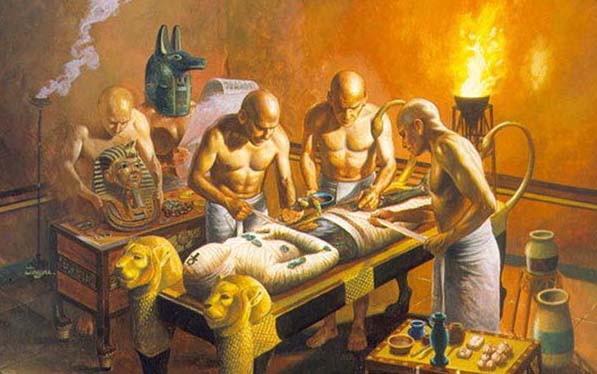
WHAT IS MUMMIFICATION?
Mummification is the process of preserving a dead body by preventing natural decomposition.
Ancient Egyptians developed highly sophisticated techniques that allowed bodies to survive for thousands of years.
The goal was not merely preservation.
The goal was:
Eternal Survival
Egyptians believed the soul needed a recognizable physical body in order to continue existing after death.
WHY DID EGYPTIANS MUMMIFY THEIR DEAD?
The answer lies in Egyptian religion.
Ancient Egyptians believed every person consisted of multiple spiritual elements, including:
- Ka (life force)
- Ba (personality)
- Akh (transformed spirit)
After death, these elements needed to reunite with the preserved body.
If the body decayed completely, this reunion could be impossible.
Mummification therefore became a crucial step toward eternal life
THE MYTHOLOGICAL ORIGINS OF MUMMIFICATION
The practice was closely linked to the story of:
Osiris
According to Egyptian mythology, Osiris was murdered by his brother Seth.
His body was restored and reassembled through the efforts of Isis.
Osiris was then resurrected and became ruler of the afterlife.
This story provided the model for human resurrection.
Every mummy symbolically became another Osiris.
THE EVOLUTION OF MUMMIFICATION
Mummification did not appear fully developed.
It evolved over thousands of years.
Predynastic Egypt
The earliest burials were simple desert graves.
The hot, dry sand naturally preserved bodies.
These naturally preserved remains likely inspired later mummification practices.
Old Kingdom
Artificial preservation techniques began to emerge.
The process remained relatively simple compared to later periods.
Middle Kingdom
Techniques improved significantly.
Internal organs began receiving greater attention.
New Kingdom
Mummification reached its highest level of sophistication.
Many of Egypt’s most famous royal mummies date from this period.
Developer Note
Insert timeline infographic:
Natural Preservation
↓
Early Mummification
↓
Advanced Mummification
↓
Royal Mummification Peak
THE 70-DAY MUMMIFICATION PROCESS
The Greek historian Herodotus described a process lasting approximately:
70 Days
Although methods varied by period and social status, the standard elite procedure involved several stages.
STEP 1
Purification of the Body
The body was washed and purified.
Priests often performed rituals while invoking divine protection.
The process was both practical and religious.
STEP 2
Removal of the Brain
One of the most famous stages.
Special instruments were inserted through the nose.
The brain was broken apart and extracted.
Because Egyptians did not consider the brain the center of intelligence, it was usually discarded.
Did You Know?
Ancient Egyptians believed the heart—not the brain—was the center of thought, memory, and emotion.
STEP 3
Removal of Internal Organs
The embalmers made an incision in the left side of the abdomen.
They removed:
- Liver
- Lungs
- Stomach
- Intestines
These organs were carefully preserved.
The heart usually remained inside the body because it would be needed during judgment in the afterlife.
Internal Link
👉 Ancient Egyptian Afterlife Beliefs
/ancient-egypt/afterlife-beliefs
STEP 4
Canopic Jars
The preserved organs were placed inside special containers known as:
Canopic Jars
Each jar was protected by one of the Four Sons of Horus.
|
Son of Horus |
Organ Protected |
|
Imsety |
Liver |
|
Hapy |
Lungs |
|
Duamutef |
Stomach |
|
Qebehsenuef |
Intestines |
Developer Note
Create illustrated infographic:
“The Four Sons of Horus and the Canopic Jars”
STEP 5
Drying with Natron
This was the most important preservation stage.
The body was covered with:
Natron
a naturally occurring salt mixture.
Natron removed moisture from the tissues.
The drying process lasted approximately:
40 Days
Without this stage, preservation would fail.
STEP 6
Filling and Reshaping the Body
After drying, the body appeared thin and shriveled.
Embalmers often added:
- Linen
- Resin
- Sawdust
- Plant fibers
to restore a more lifelike appearance.
STEP 7
Wrapping in Linen
The body was wrapped in hundreds of meters of linen.
Each layer had religious significance.
Priests inserted:
- Protective amulets
- Sacred symbols
- Magical charms
between the layers.
STEP 8
The Funerary Mask
Elite individuals often received elaborate masks.
The most famous example is:
Tutankhamun’s Golden Mask
One of the greatest treasures ever discovered.
STEP 9
The Opening of the Mouth Ceremony
One of the most important rituals.
Priests touched the mummy with sacred instruments.
The ceremony symbolically restored:
- Sight
- Hearing
- Speech
- Breathing
allowing the deceased to function in the afterlife.
WHO PERFORMED MUMMIFICATION?
Specialized embalmers carried out the work.
Many belonged to priestly groups.
They possessed:
- Anatomical knowledge
- Religious expertise
- Ritual training
Mummification was both a profession and a sacred duty
DID EVERYONE RECEIVE THE SAME TREATMENT?
No.
The quality of mummification depended largely on wealth.
Royal Mummification
The most elaborate and expensive.
Elite Mummification
High-quality preservation and richly furnished tombs.
Middle-Class Burials
Simplified procedures.
Ordinary Burials
Often limited preservation.
THE SCIENCE OF MUMMIFICATION
Modern researchers have learned a great deal through scientific study.
Techniques include:
- CT scanning
- DNA analysis
- Radiology
- Forensic examination
These methods allow researchers to investigate mummies without unwrapping them.
WHAT SCIENTISTS HAVE DISCOVERED
Mummies reveal remarkable information about:
- Health
- Diet
- Disease
- Injuries
- Genetics
- Lifespans
Modern medicine has transformed mummies into valuable historical records
THE ROYAL MUMMIES
Some of the most famous mummies belong to Egyptian rulers.
Examples include:
Ramses II
Perhaps Egypt’s greatest pharaoh.
Seti I
One of the best-preserved royal mummies ever discovered.
Ahmose I
Founder of the New Kingdom.
Hatshepsut
Whose mummy was identified through modern scientific investigation.
TUTANKHAMUN'S MUMMY
Discovered in 1922 by Howard Carter.
Tutankhamun’s mummy remains one of the most studied human remains in history.
Modern scans have revealed:
- Physical disabilities
- Family relationships
- Health problems
- Genetic information
ANIMAL MUMMIES
Humans were not the only mummies.
Millions of animal mummies have been discovered.
Examples include:
- Cats
- Crocodiles
- Ibises
- Falcons
- Dogs
These animals often served religious purposes
THE DISCOVERY OF MUMMIES
Many mummies survived because tombs remained sealed for centuries.
Others were damaged by:
- Tomb robbers
- Environmental conditions
- Early archaeological methods
Modern conservation now focuses on preserving these fragile remains.
ETHICS AND MODERN DISPLAY
Museums today face important questions.
How should human remains be displayed?
How can ancient individuals be treated respectfully?
These discussions continue among archaeologists, museums, and visitors
WHY MUMMIFICATION STILL FASCINATES US
Few ancient practices combine:
✔ Religion
✔ Science
✔ Medicine
✔ Art
✔ Ritual
✔ Archaeology
as effectively as mummification.
More than preserved bodies, mummies are direct human connections to a civilization that flourished thousands of years ago.
They allow us to look into the faces of people who believed they were preparing for eternity
FREQUENTLY ASKED QUESTIONS
How long did mummification take?
Approximately 70 days for elite burials.
Why was the brain removed?
Egyptians believed the heart, not the brain, was the center of intelligence and emotion.
Was the heart removed?
Usually no. The heart remained in the body because it was needed during the judgment of the dead.
What is natron?
A naturally occurring salt mixture used to dry and preserve the body.
Can mummies still be studied today?
Yes. Modern technologies such as CT scans and DNA analysis continue to reveal new information.
WHY THE GREAT PYRAMID STILL AMAZES THE WORLD
The Great Pyramid represents:
✔ Architectural genius
✔ Engineering innovation
✔ Mathematical precision
✔ Astronomical knowledge
✔ Religious belief
✔ Human determination
More than four thousand years after its construction, it remains one of humanity’s greatest achievements.
FREQUENTLY ASKED QUESTIONS
How old is the Great Pyramid?
Approximately 4,500 years old.
Who built the Great Pyramid?
It was built during the reign of Pharaoh Khufu.
How many stones were used?
Approximately 2.3 million blocks.
Is the Great Pyramid aligned with true north?
Yes, with extraordinary accuracy.
Did Egyptians know advanced mathematics?
They possessed sophisticated practical geometry and surveying skills, although modern interpretations involving pi and the Golden Ratio remain debated.
related journals

6 min read
6 min read
6 min read