
Our Story
Akhenaten: Egypt’s Revolutionary Pharaoh
Discover the extraordinary story of Akhenaten, the ruler who attempted to transform Ancient Egypt’s religion, founded a new capital city, introduced a radical artistic style, and created one of the most controversial periods in Egyptian history. More than 3,300 years later, historians continue to debate whether he was a visionary reformer, a religious revolutionary, or a ruler whose ambitions nearly destabilized an empire.
ARTICLE INTRODUCTION
Few individuals in Ancient Egyptian history have generated as much fascination and debate as Akhenaten.
Unlike Ramses II, whose legacy was built through military campaigns and monumental architecture, or Tutankhamun, whose fame stems from the discovery of his tomb, Akhenaten is remembered because he attempted something unprecedented.
He tried to change how Egypt worshipped its gods.
For centuries, Ancient Egyptian civilization had been built upon a complex religious system involving hundreds of deities, powerful temples, and influential priesthoods. Akhenaten challenged this entire structure.
He elevated a single deity—the Aten—and redirected the kingdom’s religious focus toward the worship of the sun’s life-giving power.
He founded a new capital city in the desert.
He transformed artistic traditions.
He altered royal imagery.
And he left behind one of the most controversial legacies in world history.
Although his revolution ultimately failed, Akhenaten’s reign remains one of the most remarkable experiments in religion, politics, and royal power ever attempted
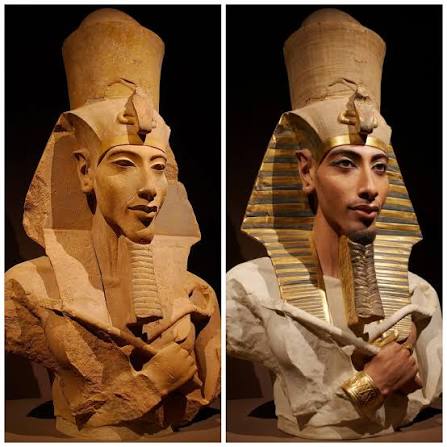
WHO WAS AKHENATEN?
Akhenaten was born as:
Amenhotep IV
during one of Egypt’s most prosperous periods.
His father, Amenhotep III, ruled over a wealthy empire that enjoyed international prestige, thriving trade networks, and extensive building projects.
When Amenhotep IV inherited the throne, Egypt stood at the height of its power.
Nothing initially suggested that his reign would become one of the most radical periods in Egyptian history.
Yet within only a few years of becoming king, he began introducing dramatic religious changes that would reshape the kingdom.
Eventually he abandoned his birth name and adopted:
Akhenaten
meaning:
“Effective for the Aten”
This new name reflected his growing devotion to a single deity.
EGYPT BEFORE AKHENATEN
To understand why Akhenaten remains so controversial, it is important to understand the world he inherited.
Ancient Egyptian religion had evolved over thousands of years.
The Egyptian pantheon included:
- Amun
- Ra
- Osiris
- Isis
- Horus
- Hathor
- Ptah
- Anubis
and many other gods.
Religious life influenced every aspect of society.
Temples functioned not only as religious centers but also as major economic and political institutions
QUICK FACTS ABOUT AKHENATEN
Fact | Details |
Birth Name | Amenhotep IV |
Throne Name | Akhenaten |
Dynasty | 18th Dynasty |
Reign | c. 1353–1336 BC |
Father | Amenhotep III |
Great Royal Wife | Nefertiti |
Capital City | Akhetaten (Amarna) |
Famous For | Aten Worship & Religious Revolution |
Successor | Tutankhamun (eventually) |
Burial Place | Believed to have been buried at Amarna before later relocation |
THE RISE OF THE ATEN
The Aten was not a completely new deity.
Earlier Egyptians already recognized the Aten as an aspect of the sun.
However, Akhenaten elevated the Aten above all other gods.
The Aten was represented as:
A Solar Disk
whose rays extended toward humanity, often ending in hands that offered life and blessings.
Under Akhenaten, the Aten became the focus of royal worship.
The king increasingly portrayed himself as the primary intermediary between humanity and the divine.
THE GREAT RELIGIOUS REVOLUTION
This was the defining event of Akhenaten’s reign.
Over time, traditional gods became less prominent in official monuments and inscriptions.
The worship of Amun was particularly targeted.
Temples dedicated to older gods lost royal support.
New temples dedicated to the Aten were constructed.
The Aten became the central focus of state religion.
This transformation represented one of the most radical religious reforms in ancient history
WAS AKHENATEN THE WORLD'S FIRST MONOTHEIST?
This remains one of the most debated questions in Egyptology.
Some scholars describe Akhenaten’s religion as:
Monotheism
the worship of a single god.
Others argue that it was closer to:
Henotheism
the elevation of one god above all others without necessarily denying their existence.
Whatever label is applied, Akhenaten’s religious system was fundamentally different from traditional Egyptian beliefs.
No earlier pharaoh had attempted such a dramatic transformation.
AKHETATEN: THE CITY BUILT FOR A GOD
Perhaps Akhenaten’s most ambitious project was the creation of an entirely new capital.
He abandoned traditional centers of power and founded:
Akhetaten
meaning:
“Horizon of the Aten”
Today the site is known as:
Amarna
Located in Middle Egypt, the city was constructed specifically to serve the Aten religion.
The project was astonishing in scale.
Within only a few years, the desert landscape was transformed into a thriving royal capital.
The city included:
- Palaces
- Temples
- Administrative buildings
- Residences
- Workshops
For a brief period, Amarna became the heart of Egypt.
LIFE IN AMARNA
Modern archaeological excavations provide an extraordinary glimpse into daily life during Akhenaten’s reign.
The city reveals:
- Royal residences
- Noble villas
- Workers’ villages
- Artistic workshops
- Religious complexes
Because Amarna was occupied for a relatively short time, it provides a unique snapshot of a specific moment in Egyptian history.
Few archaeological sites offer such detailed insight into a single royal reign.
NEFERTITI: THE QUEEN OF THE AMARNA AGE
No discussion of Akhenaten is complete without mentioning:
Queen Nefertiti
One of the most famous women in history.
Nefertiti appears prominently throughout Amarna art and inscriptions.
Unlike many queens, she often appears participating in religious rituals and royal ceremonies alongside the king.
Some scholars believe she held exceptional political influence.
Others suggest she may even have ruled independently for a short period after Akhenaten’s death.
THE AMARNA ART REVOLUTION
Akhenaten transformed not only religion but also art.
Traditional Egyptian art emphasized:
- Idealized bodies
- Formal poses
- Timeless perfection
Amarna art broke many of these conventions.
Artists created scenes showing:
- Family life
- Affection
- Children
- Natural movement
- Emotional expression
These depictions feel surprisingly modern compared to earlier Egyptian art.
The royal family appears eating, embracing, and interacting in ways rarely seen elsewhere in Egyptian history.
WHY DOES AKHENATEN LOOK SO DIFFERENT?
One of the most intriguing aspects of Amarna art is the unusual appearance of Akhenaten.
Many statues and reliefs depict him with:
- An elongated skull
- Narrow chest
- Wide hips
- Long face
- Prominent abdomen
These images have generated decades of debate.
WAS AKHENATEN SICK?
Over the years, numerous theories have attempted to explain his appearance.
Researchers proposed conditions such as:
- Marfan Syndrome
- Froehlich Syndrome
- Genetic disorders
- Hormonal conditions
Modern scholarship is far more cautious.
Most Egyptologists now believe these depictions were primarily:
Religious and Artistic Symbolism
Rather than realistic portraits.
Akhenaten likely wanted to appear visually distinct from previous rulers.
The unusual artistic style emphasized his unique relationship with the Aten and his role as a transformative king.
At present, there is no conclusive evidence that Akhenaten suffered from a severe physical disorder.
THE COLLAPSE OF THE REVOLUTION
Akhenaten’s religious reforms depended heavily on his personal authority.
When he died, the system began to unravel.
His successors gradually abandoned Aten worship.
Traditional gods returned.
Temples reopened.
The city of Amarna was abandoned.
Egypt effectively reversed much of the revolution.
WHY WAS AKHENATEN ERASED FROM HISTORY?
Later generations viewed Akhenaten’s reign with suspicion.
His monuments were dismantled.
His names were removed from inscriptions.
His city was abandoned.
Official king lists often excluded him.
For centuries, his memory nearly disappeared from history.
Ironically, these attempts to erase him only increased modern fascination with his story.
WHY HISTORIANS STILL DEBATE AKHENATEN
More than three millennia later, Akhenaten continues to divide opinion.
Was he:
A Religious Visionary?
A ruler who introduced revolutionary ideas.
A Political Reformer?
A king attempting to weaken entrenched priestly power.
A Failed Idealist?
A ruler whose reforms collapsed almost immediately after his death.
Egypt’s Most Unusual Pharaoh?
Perhaps.
The answer may contain elements of all these interpretations.
AKHENATEN'S LEGACY
His reign remains significant because it demonstrates:
✔ The power of ideas
✔ The limits of royal authority
✔ The relationship between religion and politics
✔ The importance of cultural identity
✔ The extraordinary adaptability of Ancient Egypt
Few pharaohs provoke as many questions or inspire as much debate.
FREQUENTLY ASKED QUESTIONS
Was Akhenaten the father of Tutankhamun?
Most modern evidence suggests he probably was.
Why is Akhenaten famous?
For promoting the worship of the Aten and launching a religious revolution.
What happened to Amarna?
The city was abandoned after the collapse of Akhenaten’s reforms.
Was Akhenaten married to Nefertiti?
Yes, Nefertiti was his Great Royal Wife and one of the most influential queens in Egyptian history.
Has Akhenaten’s mummy been found?
Possibly. Many scholars believe the KV55 mummy may be Akhenaten, but the identification remains debated.
related journals

6 min read
6 min read
6 min read