
Our Story
Ancient Egyptian Food & Drink
Discover the complete story of the Great Pyramid of Giza, the largest pyramid ever built and the only surviving Wonder of the Ancient World. Explore its history, construction, interior chambers, mathematical precision, astronomical alignments, and the enduring mysteries that continue to fascinate archaeologists, engineers, and travelers alike.
overview
When most people think about romantic destinations, places like Italy, the Maldives, or the Greek Islands often come to mind.
Few immediately think of Egypt.
Yet those who visit often discover something unexpected.
Egypt offers one of the most unique romantic travel experiences in the world.
Where else can you watch the sun set behind the Giza Pyramids, sail privately along the Nile River, dine beneath ancient temples, stay in legendary heritage hotels, and wake to views that have inspired travelers for thousands of years?
Unlike destinations built solely around beaches or resorts, Egypt combines romance with discovery.
Every day brings a new landscape, a new story, and a new shared experience.
For couples seeking something deeper than a traditional vacation, Egypt delivers a journey that is both meaningful and unforgettable.
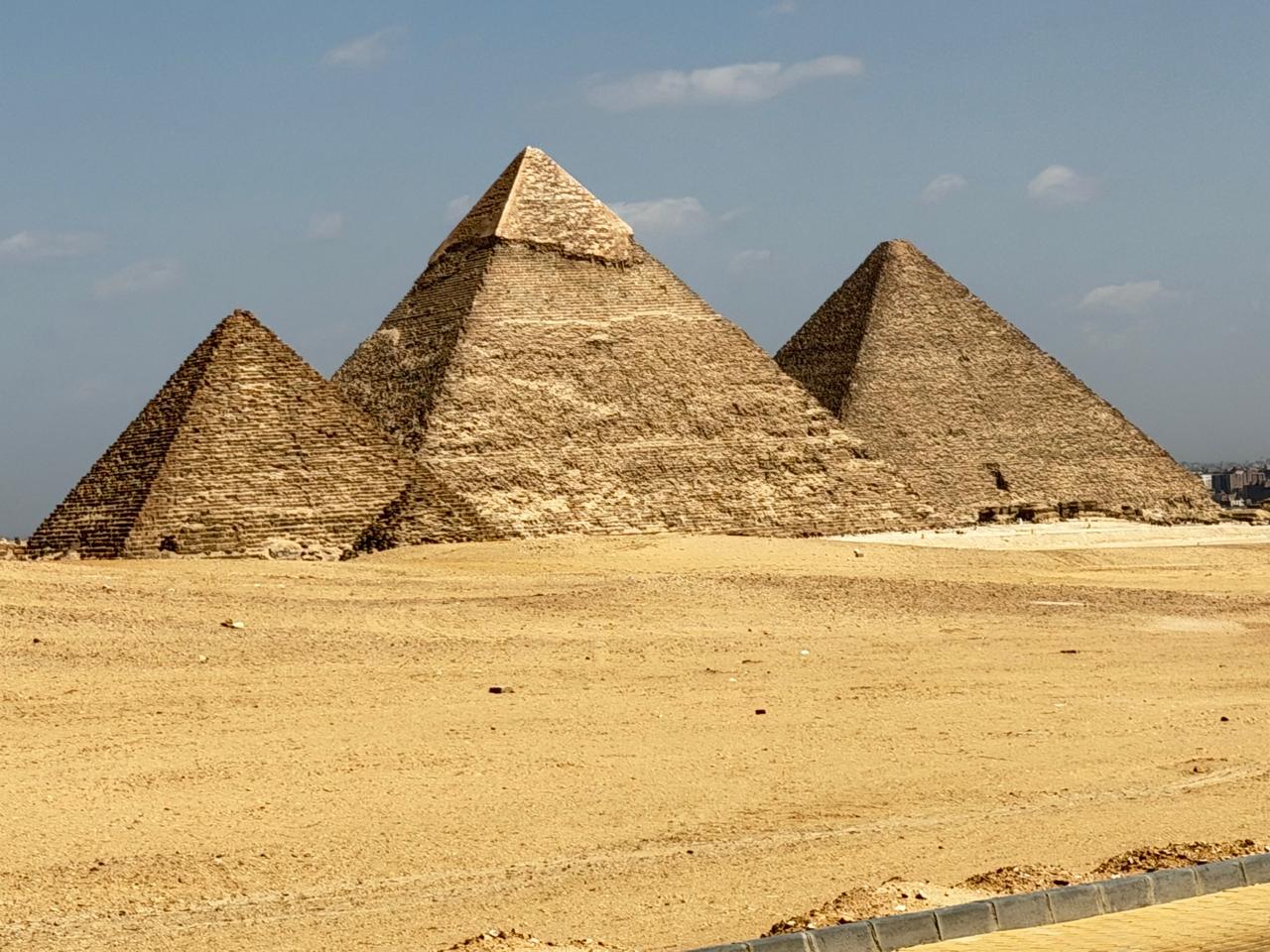
WHO BUILT THE GREAT PYRAMID?
The pyramid was built for:
Pharaoh Khufu
One of Ancient Egypt’s most powerful rulers.
WHY WAS THE PYRAMID BUILT?
To modern visitors, the pyramid appears to be an enormous monument.
To Ancient Egyptians, it was far more.
It functioned as:
- Royal tomb
- Religious monument
- Symbol of divine kingship
- Gateway to the afterlife
Egyptians believed the king would continue his existence after death and eventually join the gods.
The pyramid was designed to support that journey for eternity.
QUICK FACTS ABOUT THE GREAT PYRAMID
Fact | Details |
Ancient Name | Akhet Khufu (Horizon of Khufu) |
Builder | Pharaoh Khufu |
Dynasty | Fourth Dynasty |
Construction Date | c. 2580–2560 BC |
Original Height | 146.6 meters |
Current Height | 138.8 meters |
Base Length | 230.4 meters per side |
Stone Blocks | Approx. 2.3 million |
Estimated Weight | Over 6 million tons |
Status | Only Surviving Ancient Wonder |
THE SCALE OF THE GREAT PYRAMID
Numbers alone help explain the monument’s extraordinary nature.
The pyramid contains approximately:
2.3 Million Stone Blocks
Average block weight:
2.5 Tons
Some granite blocks:
Up to 80 Tons
Total estimated weight:
More Than 6 Million Tons
For nearly four thousand years, it remained the tallest building on Earth.
No cathedral, palace, castle, or skyscraper surpassed it until the Middle Ages.
THE GEOMETRY OF THE GREAT PYRAMID
One reason the Great Pyramid fascinates mathematicians is its extraordinary geometric precision.
The monument is essentially a near-perfect square pyramid.
Original Height
146.6 meters
Base Length
230.4 meters
Slope Angle
Approximately:
51° 50′
This angle creates the pyramid’s distinctive shape and contributes to its structural stability.
THE REMARKABLE ACCURACY OF THE BASE
One of the most astonishing achievements is the accuracy of the foundation.
The four sides differ in length by only a few centimeters.
The entire base is nearly level despite covering more than thirteen acres.
Modern engineers continue to admire this precision.
Achieving such accuracy without modern instruments required exceptional surveying skills.
DOES THE PYRAMID CONTAIN PI (π)?
This is one of the most debated mathematical topics associated with the pyramid.
When certain measurements are compared, a relationship appears that closely approximates:
π (3.14159)
Specifically:
The perimeter of the base divided by twice the original height produces a value very close to pi.
Some researchers believe this was intentional.
Others argue it is a byproduct of the chosen design.
Most Egyptologists remain cautious.
While the relationship is fascinating, there is no direct evidence that Egyptian architects consciously incorporated the modern mathematical concept of pi.
DOES THE PYRAMID CONTAIN PI (π)?
Another frequently discussed theory involves:
The Golden Ratio (Phi)
Approximately:
1.618
Some calculations based on the pyramid’s dimensions produce values close to this ratio.
As with pi, scholars disagree about whether this was intentional.
The important point is that the pyramid demonstrates sophisticated geometry regardless of whether modern mathematical concepts were deliberately encoded.
ASTRONOMICAL ALIGNMENT
Another frequently discussed theory involves:
The Golden Ratio (Phi)
Approximately:
1.618
Some calculations based on the pyramid’s dimensions produce values close to this ratio.
As with pi, scholars disagree about whether this was intentional.
The important point is that the pyramid demonstrates sophisticated geometry regardless of whether modern mathematical concepts were deliberately encoded.
HOW DID THE BUILDERS FIND TRUE NORTH?
Ancient Egyptians had no magnetic compass.
Instead, they likely used:
Astronomical Observation
By tracking specific stars and their movements, surveyors could determine cardinal directions with remarkable precision.
Several theories suggest the builders used circumpolar stars—stars that never set below the horizon.
This allowed them to establish true north far more accurately than many ancient civilizations.
THE STARS AND THE AFTERLIFE
Astronomy played an important role in Egyptian religion.
Certain stars were associated with:
- Eternity
- Divine power
- The afterlife
The king’s spirit was believed to ascend into the heavens.
For this reason, celestial alignment may have held both practical and religious significance
INSIDE THE GREAT PYRAMID
Unlike many pyramids, the Great Pyramid contains a complex interior.
Major components include:
Descending Passage
Leading downward into the bedrock.
Subterranean Chamber
An unfinished chamber carved beneath the pyramid.
Its exact purpose remains uncertain.
Ascending Passage
A remarkable corridor leading upward.
Grand Gallery
One of the most extraordinary spaces inside the pyramid.
Dimensions
Length:
Approximately 47 meters
Height:
Approximately 8.6 meters
The precision of its construction continues to impress engineers.
Queen’s Chamber
Located near the center of the pyramid.
Despite its name, no queen was buried here.
Its true purpose remains debated.
King’s Chamber
The most famous room inside the pyramid.
Constructed from granite transported from Aswan.
THE MYSTERY OF THE SHAFTS
Small shafts extend from the King’s Chamber and Queen’s Chamber.
For many years they were called:
Air Shafts
However, they may have had symbolic or astronomical purposes.
Some researchers believe they point toward stars associated with royal resurrection.
The exact function remains debated.
HOW DID THE PYRAMID SURVIVE?
The pyramid’s survival reflects brilliant engineering.
Several factors contributed:
Massive Foundation
Built directly on bedrock.
Weight Distribution
The pyramid’s shape naturally directs loads downward.
High-Quality Construction
Blocks were carefully fitted together.
Dry Climate
Egypt’s environment helped preserve the structure.
THE MISSING CASING STONES
Today the pyramid appears rough.
Originally it looked very different.
The monument was covered in:
Highly Polished White Limestone
These casing stones reflected sunlight brilliantly.
Ancient visitors may have seen the pyramid shining across the landscape.
Many casing stones were removed during later centuries for construction projects in Cairo.
MODERN DISCOVERIES
Despite centuries of research, the Great Pyramid still reveals new secrets.
Recent technologies include:
- Laser scanning
- Thermal imaging
- Muon scanning
These methods have identified previously unknown internal voids.
The Big Void
Discovered in 2017.
One of the most significant pyramid discoveries in modern times.
Its purpose remains unknown.
MYTHS ABOUT THE GREAT PYRAMID
The monument has inspired countless theories.
Among the most famous:
Aliens Built It
No archaeological evidence supports this.
Lost Advanced Civilization
No evidence supports this.
Secret Prophecies Hidden Inside
No credible evidence.
Ancient Power Plant Theory
Rejected by mainstream archaeology.
The true story of the pyramid is already extraordinary without fictional explanations.
WHY THE GREAT PYRAMID STILL AMAZES THE WORLD
The Great Pyramid represents:
✔ Architectural genius
✔ Engineering innovation
✔ Mathematical precision
✔ Astronomical knowledge
✔ Religious belief
✔ Human determination
More than four thousand years after its construction, it remains one of humanity’s greatest achievements.
FREQUENTLY ASKED QUESTIONS
How old is the Great Pyramid?
Approximately 4,500 years old.
Who built the Great Pyramid?
It was built during the reign of Pharaoh Khufu.
How many stones were used?
Approximately 2.3 million blocks.
Is the Great Pyramid aligned with true north?
Yes, with extraordinary accuracy.
Did Egyptians know advanced mathematics?
They possessed sophisticated practical geometry and surveying skills, although modern interpretations involving pi and the Golden Ratio remain debated.
related journals

6 min read
6 min read
6 min read