
Our Story
Ramses II: Egypt’s Greatest Pharaoh
Discover the remarkable story of Ramses II, one of the most powerful rulers in world history. From the colossal temples of Abu Simbel to the vast halls of Karnak, Ramses II transformed Egypt through military campaigns, monumental architecture, diplomacy, and an extraordinary reign that lasted more than six decades.
ARTICLE INTRODUCTION
More than three thousand years after his death, Ramses II remains one of the most recognizable figures of ancient Egypt.
His image appears across Egypt in colossal statues, towering temples, intricate reliefs, and magnificent monuments that continue to inspire awe among visitors from around the world.
Known as:
Ramses the Great
he ruled Egypt during one of its most prosperous and influential periods.
For nearly 67 years, Ramses II expanded Egypt’s influence, launched military campaigns, commissioned extraordinary building projects, and established a legacy so powerful that later generations regarded him as the ideal pharaoh.
Today, travelers encounter his presence throughout Egypt:
at Abu Simbel, Luxor, Karnak, the Ramesseum, and even inside the Grand Egyptian Museum.
Few rulers in history have left such a visible mark on their civilization
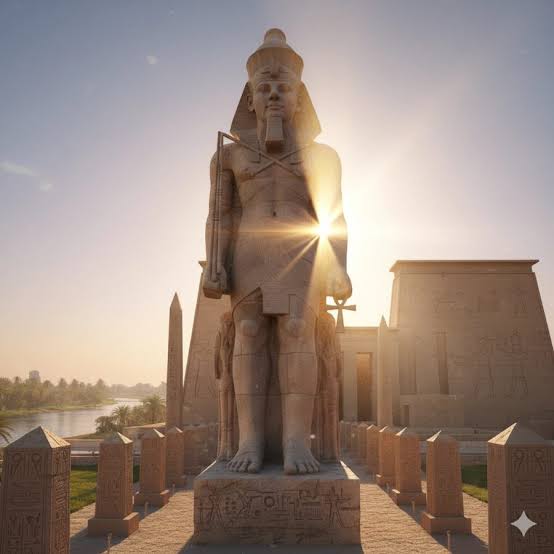
WHO WAS RAMSES II?
Ramses II was the third ruler of Egypt’s Nineteenth Dynasty and one of the most successful pharaohs of the New Kingdom period.
Born into a powerful royal family, he was prepared from childhood for leadership.
His father, Pharaoh Seti I, recognized his abilities early and involved him in military affairs and state administration while he was still young.
As a prince, Ramses gained experience in:
- Warfare
- Government
- Diplomacy
- Religious ceremonies
These experiences prepared him to inherit one of the most powerful kingdoms in the ancient world.
When he became pharaoh around 1279 BC, Egypt was already prosperous.
Under Ramses II, it became even more influential.
THE WORLD OF RAMSES II
To understand Ramses II, it is important to understand Egypt during his reign.
The New Kingdom represented the height of ancient Egyptian power.
Egypt controlled territories stretching far beyond its modern borders and maintained extensive diplomatic and trade relationships across the ancient Near East.
During Ramses II’s reign:
✔ International trade flourished
✔ Monumental construction reached new heights
✔ Egyptian religion remained central to society
✔ Military power secured Egypt’s borders
✔ Art and culture thrived
His era is often considered one of Egypt’s golden ages.
QUICK FACTS ABOUT AKHENATEN
Fact | Details |
Full Name | Usermaatre Setepenre Ramses II |
Dynasty | 19th Dynasty |
Reign | c. 1279–1213 BC |
Length of Reign | Approximately 66–67 Years |
Father | Seti I |
Principal Wife | Queen Nefertari |
Children | More than 100 |
Famous For | Abu Simbel, Battle of Kadesh, Monument Building |
Burial Place | Valley of the Kings (KV7) |
RAMSES II THE WARRIOR KING
One of Ramses II’s greatest ambitions was to maintain Egyptian dominance over strategic territories in the Levant.
This led to several military campaigns.
One of Ramses II’s greatest ambitions was to maintain Egyptian dominance over strategic territories in the Levant.
This led to several military campaigns.
RAMSES II THE MASTER BUILDER
This was the defining event of Akhenaten’s reign.
Over time, traditional gods became less prominent in official monuments and inscriptions.
The worship of Amun was particularly targeted.
Temples dedicated to older gods lost royal support.
New temples dedicated to the Aten were constructed.
The Aten became the central focus of state religion.
This transformation represented one of the most radical religious reforms in ancient history
ABU SIMBEL
Perhaps Ramses II’s greatest architectural achievement.
Carved directly into the sandstone cliffs near Lake Nasser, the temples of Abu Simbel remain among Egypt’s most spectacular monuments.
Highlights include:
- Four colossal statues
- Detailed battle reliefs
- Solar alignment phenomenon
- Temple of Queen Nefertari
Abu Simbel was designed to project royal power for eternity.
More than three millennia later, it continues to do exactly that.
THE RAMESSEUM
Located on Luxor’s West Bank, the Ramesseum served as Ramses II’s mortuary temple.
Although partially ruined today, it once stood among Egypt’s most impressive religious complexes.
Its giant fallen statue inspired Percy Shelley’s famous poem:
“Ozymandias.”
KARNAK TEMPLE
Ramses II expanded several areas of Karnak and added numerous monuments.
Today, visitors can still see evidence of his contributions throughout the complex.
THE GREAT ROYAL WIFE: QUEEN NEFERTARI
No discussion of Ramses II is complete without mentioning Nefertari.
She was not merely a queen.
She was his most beloved wife and one of the most influential royal women in Egyptian history.
Ramses honored her in extraordinary ways.
Most notably:
The Temple of Nefertari at Abu Simbel
A distinction granted to very few queens
RAMSES II'S FAMILY
Ramses II fathered an enormous royal family.
Historians estimate he had:
More Than 100 Children
Many princes and princesses occupied important roles within Egyptian society.
Several sons were expected to succeed him but died before the aging king.
Ultimately, his thirteenth son became Pharaoh Merneptah.
RELIGION AND DIVINE KINGSHIP
Like all pharaohs, Ramses II was considered both ruler and divine intermediary.
He presented himself as:
- Protector of Egypt
- Defender of the gods
- Maintainer of cosmic order
Religious imagery appears throughout his monuments.
His temples celebrate:
- Amun
- Ra
- Ptah
- Hathor
and many other deities.
THE DEATH OF RAMSES II
After one of the longest reigns in Egyptian history, Ramses II died around 1213 BC.
He was approximately:
90 Years Old
an extraordinary age for the ancient world.
His death marked the end of an era.
Although Egypt remained powerful, no later ruler would match the scale of his influence.
THE MUMMY OF RAMSES II
The mummy of Ramses II survives today.
Modern examinations have revealed fascinating details about:
- His health
- Physical appearance
- Age at death
His mummy is one of the most important royal remains ever discovered.
WHY RAMSES II IS CALLED "THE GREAT"
Historians remember Ramses II because he excelled in multiple areas:
✔ Military Leadership
✔ Monumental Construction
✔ Diplomacy
✔ Longevity
✔ Religious Influence
✔ Cultural Legacy
Few rulers in world history achieved success on such a scale.
FREQUENTLY ASKED QUESTIONS
Was Ramses II the greatest pharaoh?
Many historians consider him the greatest due to his long reign, military achievements, and extensive building projects.
How long did Ramses II rule?
Approximately 66–67 years.
Is Ramses II connected to Abu Simbel?
Yes. Abu Simbel was commissioned by Ramses II and remains his most famous monument.
Who was Ramses II’s wife?
His most famous wife was Queen Nefertari.
Where was Ramses II buried?
In tomb KV7 within the Valley of the Kings.
related journals

6 min read
6 min read
6 min read